Abstract
Public universities serve as vibrant pillars of learning, research, and societal development. However, these institutions increasingly face substantial challenges related to retaining skilled employees. The departure of academic and administrative personnel disrupts institutional continuity, compromises service delivery, and weakens educational quality. As a result, employee retention has emerged as a strategic priority in higher education management. The growing pressure on public universities, including heavy workload, constrained resource, and employee welfare concerns, has intensified the need for structured wellness initiatives that support workforce sustainability. This study presents a structured desk review investigating the influence of wellness programs on employee retention in public universities in Kenya. The review specifically examines how work–life balance practices and work environment conditions contribute to retention outcomes. Guided by Social Exchange Theory (SET), the study conceptualizes wellness programs as reciprocal organizational investments that strengthen employee commitment and loyalty. A systematic desk review methodology involving literature selection, thematic analysis, and analytical synthesis of peer-reviewed sources was applied. The synthesis demonstrates that wellness initiatives, including flexible work arrangements, supportive leadership, inclusive organizational culture, and employee welfare programs, enhance job satisfaction, psychological safety, and institutional attachment. These outcomes collectively influence retention behavior. The findings further indicate that the effectiveness of wellness initiatives depends on institutional consistency, implementation quality, and alignment with broader human resource practices. By integrating fragmented literature into a coherent analytical framework, this study contributes to evidence-based human resource management discourse in higher education.
|
Published in
|
Journal of Human Resource Management (Volume 14, Issue 1)
|
|
DOI
|
10.11648/j.jhrm.20261401.20
|
|
Page(s)
|
98-105 |
|
Creative Commons
|

This is an Open Access article, distributed under the terms of the Creative Commons Attribution 4.0 International License (http://creativecommons.org/licenses/by/4.0/), which permits unrestricted use, distribution and reproduction in any medium or format, provided the original work is properly cited.
|
|
Copyright
|
Copyright © The Author(s), 2026. Published by Science Publishing Group
|
Keywords
Wellness Programs, Employee Retention, Work Environment, Work life Balance, Desk Review
1. Introduction
Human Resource Management (HRM) plays a foundational role in organizational sustainability through the recruitment, development, performance management, and welfare coordination of employees. Effective human resource practices are associated with improved morale, productivity, and job satisfaction, positioning institutions for long-term stability.
| [21] | Rafiei, N., & Davari, F. (2020). The role of human resources management on enhancing the teaching skills of faculty members. Materia socio-medica, 27(1), 35-41
https://doi.org/10.5455/msm.2014.27.35-38 |
[21]
emphasize that structured workforce management enhances institutional performance, while
| [5] | Fenech, R., Baguant, P., & Ivanov, D. (2021). The changing role of human resource management in an era of digital transformation. Journal of Management Information & Decision Sciences, 22(2), 7-12. |
[5]
note that investment in employee welfare strengthens organizational resilience. Advances in technology continue to transform human resource functions, enabling data-driven workforce decisions and more responsive employee management systems
| [10] | Jabbour, C. J. C., & Santos, F. C. A. (2022). The central role of human resource management in the search for sustainable organizations. The international journal of human resource management, 19(12), 2133-2154
https://doi.org/10.1080/09585190802479389 |
[10]
.
In today’s dynamic labor environment, retaining talented employees has become increasingly important. Organizations incur substantial financial and operational costs when experienced staff leave, including recruitment expenses, training investments, and disruptions to productivity
| [8] | Htun, W. T., & Bhaumik, A. (2022). Employees job satisfaction and retention at workplace. Journal of Positive School Psychology, 6(3), 4342-4346. |
[8]
. High retention levels foster collaboration, preserve institutional memory, and strengthen workplace culture, reinforcing relationships among colleagues and stakeholders
| [25] | Sorn, M. K., Fienena, A. R., Ali, Y., Rafay, M., & Fu, G. (2023). The effectiveness of compensation in maintaining employee retention. Open Access Library Journal, 10(7), 1-14.
https://doi.org/10.4236/oalib.1110394 |
[25]
.
argues that employee retention is closely linked to professional growth opportunities and supportive work environments that encourage engagement and commitment.
Countries worldwide vary in the way they ensure employee retention rates within their institutions of higher learning. For instance, majority of universities in Finland prioritizes employee welfare by applying flexible work schedules, substantial parental leave plans, and mental health assistance strategies
| [9] | Iyiola, F. A. (2024). Strategies to Enhance Employee Knowledge Retention in Public and Private Universities (Doctoral dissertation, Walden University). |
[9]
.
| [2] | Arkoudea, D. (2024). Navigating occupational stress in Swedish Universities: An HR Perspective (University of Gothenburg). |
[2]
observe that the academic staff in Sweden is inspired in taking an individual academic growth in form of research vacations or equally wellness days, which improves their output and loyalty within the institution. In Singapore, universities utilize data analytics to evaluate workplace culture and refine employee experience through evidence-based interventions.
The Universities in have initiated a very strong programs meant for improving employee engagement with an emphasis of developing their profession and also offer chances for continuous learning to their academic staff including workshops, courses, and mentorship packages personalized for staff
| [18] | Ngcamu, B. S., & Mantzaris, E. (2023). Corruption detection systems and skills, and employee retention in South African universities. Journal of Academic Ethics, 21(3), 519-539.
https://doi.org/10.1007/s10805-022-09466-0 |
[18]
.
| [23] | Salau, O., Worlu, R., Osibanjo, A., Adeniji, A., Atolagbe, T., & Salau, J. (2021). Determinants of retention strategies and sustainable performance of academic staff of government-owned universities in Nigeria. F1000Research, 9, 902.
https://doi.org/10.12688/f1000research.25011.2 |
[23]
observe that public universities in Nigeria have put in place proper strategies of recognizing and rewarding higher performing employees through regular celebrations of achievements in awarding and acknowledging them publicly. According to
| [4] | Boakye, A. O., Arpoh-Baah, B., Odoom, D., Afram, K. O. A. O., Addai, P., & Agyemang, D. (2022). Employee retention in institutions of higher learning: A study of some selected university colleges in Ghana. Journal of education and practice, 13(5), 42-53 https://doi.org/10.7176/jep/13-5-06 |
[4]
, the universities in Ghana embraces the significance of promoting teamwork and collaborations using team building activities and social occasions which has built strongly a spirit of comradeship and created a feeling of belonging amongst their staff members.
Kenya with more than 70 universities, most of the universities have invested in building an inclusive work atmosphere through implementing consistent feedback, mentorship packages, and appreciation initiatives that rejoice staff attainments making them feel appreciated and endowed
| [15] | Muma, M. M., Ochego, C., Nzulwa, J., Ombui, K., Odhiambo, R., Wekesa, S., & Charles, M. (2019). Influence of employee relations strategies on retention of employees in universities in Kenya. International Journal of Social Science and Humanities Research, 7(2), 1-27. |
[15]
.
| [20] | Nkatha, M. F., & Kevin, W. (2022). Effects of employer branding on employee attraction and retention among institutions of higher learning; A case study of public universities in south eastern Kenya. International Journal of Business Management, 5(2), 127-143. |
[20]
indicate that majority of Universities in Kenya have adopted sustained learning and training programs for their employees by offering programs such as conferences and advancement of their studies, thus demonstrating their obligation to their long-term objectives. According to
| [28] | Tomeyan, S. C., & Mose, T. (2025). Talent management and employee performance in private universities in Kenya. International Journal of Social Sciences Management and Entrepreneurship (IJSSME), 9(1). |
[28]
, Universities in Kenya are providing mental health programs, fitness workshops and entertaining activities aimed at reducing burnout and promoting their employees’ general welfare, which is fundamental in retaining experienced employees.
A supportive work environment encompasses physical infrastructure, organizational culture, and interpersonal relationships that shape employee wellbeing
| [17] | Naz, S., Li, C., Nisar, Q. A., Khan, M. A. S., Ahmad, N., & Anwar, F. (2020). A study in the relationship between supportive work environment and employee retention: Role of organizational commitment and person-organization fit as mediators. Sage Open, 10(2).
https://doi.org/10.1177/2158244020924694 |
[17]
. Positive environments increase job satisfaction and retention by fostering recognition, safety, and belonging
| [34] | Yusliza, M. Y., Noor-Faezah, J., Ali, N. A., Mohamad-Noor, N. M., Ramayah, T., Tanveer, M. I., & Fawehinmi, O. (2021). Effects of supportive work environment on employee retention: the mediating role of person-organisation fit. Industrial and Commercial Training, 53(3), 201-216.
https://doi.org/10.1108/ict-12-2019-0111 |
[34]
. Similarly, work–life balance initiatives enable employees to manage professional and personal responsibilities effectively, reducing burnout and promoting productivity
| [1] | Al-Harthy, B., & Yusof, R. (2022). A Conceptual Paper on Compensation and Benefits, Job Security, Work-Life Balance, Employee Retention and Localization in Oman. Global Business & Management Research, 14. |
| [3] | Bahar, A. M., Islam, M. A., Hamzah, A., Islam, S. N., & Reaz, M. D. (2022). The efficacy of work-life balance for young employee retention: a validated retention model for small private industries. International Journal of Process Management and Benchmarking, 12(3), 367-394.
https://doi.org/10.1504/ijpmb.2022.122202 |
[1, 3]
. When employees experience adequate recovery time and autonomy, they demonstrate greater focus and institutional commitment
| [22] | Raghuwanshi, S. (2023). Impact of work-life balance on employee retention and organisational performance (Doctoral dissertation, Dublin, National College of Ireland). |
[22]
.
Within higher education, where academic and administrative roles involve high cognitive and emotional demands, wellness programs should be viewed as strategic institutional investments rather than peripheral benefits. They shape employee perceptions of fairness, institutional care and professional respect, which are the key drivers of retention behavior.
Statement of the Problem
Employee retention remains a pressing challenge within Kenya’s public universities, with direct implications for academic quality, institutional performance, and student outcomes
| [26] | Taiko, W. (2024). Effect of staff retention strategies on organizational performance of public institutions in Kenya. Journal of Human Resource & Leadership, 8(4), 30-45.
https://doi.org/10.53819/81018102t2427 |
[26]
. Despite ongoing reforms, many institutions continue to experience elevated turnover rates. Data from the Commission for University Education (CUE) indicate that employee retention within Kenyan universities remains comparatively low, reflecting persistent dissatisfaction associated with delayed compensation, limited professional development opportunities, and heavy workloads (CUE, 2025).
Currently, there is a rising fear over employee turnover rates within several sectors amongst them the higher education whereby Universities in Kenya are not left out
| [14] | Mugo, M. N., & Siagi, A. (2024). Factors affecting retention of academic staff in selected private chartered universities in Kiambu County Kenya. International Journal of Social Sciences Management and Entrepreneurship (IJSSME), 8(2). |
[14]
.
| [27] | Thuo, E. M., & Wambugu, T. (2022). Influence of employee welfare practices on job satisfaction in selected universities in Kenya. International Journal of Social Science and Humanities Research, 10(3), 399-420. |
[27]
argue that since Universities usually encounter challenges like higher workloads and are pressurized produce research leads to faculty and staff burnout.
Although wellness programs are increasingly promoted as mechanisms for enhancing employee satisfaction, their implementation within Kenyan universities remains uneven and inconsistently integrated. Without structured alignment with broader human resource strategies, wellness initiatives risk being symbolic rather than impactful. This study therefore seeks to examine how wellness programs, particularly work–life balance and work environment structures, influence employee retention in public universities in Kenya.
Objective of the Study
General Objectives
The study investigates the influence of wellness programs on employee retention in public universities in Kenya
Specific Objectives
1) To examine the influence of work-life balance on employee retention in public universities in Kenya
2) To assess the influence of work environment conditions on employee retention in public universities in Kenya
2. Literature Review
Theoretical Literature Review
The Social Exchange Theory, originally developed by Homans (1958), provides a foundational framework for understanding how interpersonal and organizational relationships are shaped through reciprocal exchanges of value. The theory proposes that social behavior is guided by an evaluation of perceived benefits and costs, where individuals seek to maximize positive outcomes while minimizing negative consequences. Within organizational settings, this exchange extends beyond material rewards to include emotional support, professional recognition, and psychological wellbeing.
Homans (1958) introduced guiding propositions that explain behavioral continuity in exchange relationships. The success proposition suggests that behaviors followed by rewarding outcomes are likely to be repeated, while the stimulus proposition emphasizes that individuals are drawn toward environments associated with prior positive experiences. These principles imply that employees are more inclined to remain committed to institutions that consistently provide meaningful professional and welfare benefits.
Tucker et al
| [30] | Tucker, D. (2010). Social exchange theory: John Thibaut & Harold Kelley. In The Proceedings of the Laurel Highlands Communications Conference (pp. 124-130). Indiana University of Pennsylvania, Department of Communications Media. |
[30]
expanded the theory by introducing the concept of a
comparison level, which represents the benchmark individuals use to evaluate the fairness and satisfaction of exchanges. Employee retention decisions are therefore influenced not only by immediate rewards but also by expectations formed through prior experiences and perceived alternatives.
| [13] | Molm, L. D. (2015). Homans's vision of social exchange. In George C. Homans (pp. 135-156). Routledge. |
[13]
further emphasized the social dimension of exchange, noting that trust, shared norms, and relational obligations shape long-term commitment. This perspective highlights that retention is embedded within broader social and institutional relationships rather than isolated transactional interactions.
Within the context of public universities in Kenya, Social Exchange Theory suggests that employees evaluate institutional support; such as professional development opportunities, wellness initiatives, recognition, and a supportive work environment, as part of an ongoing reciprocal relationship. When employees perceive fairness, care, and institutional investment in their wellbeing, they are more likely to respond with loyalty, engagement, and continued service. This theoretical lens therefore provides a robust explanation for how wellness programs influence retention outcomes by reinforcing reciprocal commitment.
Empirical Literature Review
Work Life Balance and Employee Retention
Work–life balance has emerged as a significant determinant of employee satisfaction and retention, particularly in high-demand professional environments. The concept refers to the ability of employees to harmonize occupational responsibilities with personal and family obligations without experiencing excessive strain. Institutions that promote flexibility, workload moderation, and recovery opportunities contribute to healthier and more sustainable work engagement.
Karanja et al
| [11] | Karanja, B. G. (2025). The influence of work life balance on intention to leave among staff in public Universities in Kenya. International Journal of Academic Accounting, Finance & Management Research, 4(1), 5-11. |
[11]
examined the relationship between work–life balance and turnover intention among employees in Kenyan public universities using a cross-sectional design. The findings revealed that employees experienced substantial work-related pressures that affected their personal wellbeing, with work–life balance accounting for a measurable proportion of turnover intention. Although the study identified important associations, its design limits causal interpretation, highlighting the need for broader analytical synthesis.
Similarly,
| [7] | Gundi, C. N., Tumwet, E. C., & Bowen, D. (2024). Effect of work-life balance on employee retention of Egerton University Academic Staff, Nakuru County, Kenya. European Journal of Human Resource Management Studies, 2(1), 9-13
https://doi.org/10.46827/ejhrms.v8i1.1777 |
[7]
assessed the effect of work-life balance on employee retention of Egerton University Academic Staff, Nakuru County, Kenya. The research employed a causal research design with a sample size of 202 academic staff members, determined using the Taro Yamane formula. Data was collected through structured questionnaires and analyzed using descriptive statistics and linear regression analysis. The findings revealed a strong positive correlation (R = 0.863) between flexible working arrangements and employee retention, with flexible working arrangements explaining 74.5% of the variance in employee retention. The study found that aspects such as flexible teaching schedules, work setups that boost improvement, and arrangements that enhance job satisfaction and reduce job stress significantly contribute to employee retention. The study has a methodological gap as it applied causal research design.
Nkanata et al
| [19] | Nkanata, S. N., Muchangi, D., & Kiiru, G. (2021). Influence of Work Schedules on Staff Retention in Public Level Five Hospitals in Kenya: Moderating Effect of Perceived Organizational Support. International Journal of Economics, Business and Management Research, 5(9), 44, 60-72. |
[19]
investigated the influence of work schedules on staff retention in public level five hospitals in Kenya: moderating effect of perceived organizational support. The study embraced descriptive and correlational research designs. The study target population was 472 doctors, 3318 nurses and 449 clinical officers from the 11 available public level five hospitals in Kenya. The study also used proportionate stratified random sampling to select eight (8) public level five hospitals, and a total sample size of 40 doctors, 278 nurses, and 37 clinical officers. To select the study participants in each stratum, Simple random sampling was used. Data was collected using a semi-structured questionnaire. The study found out that the availability of work schedules was not a motivating factor that could influence medic’s decision to leave their current workplace. A contextual gap exists since the study focused on in public level five hospitals in Kenya.
Sindhuja et al
| [24] | Sindhuja, K., & Subramanian, S. S. (2020). Impact of work-life balance on employee retention-a study on banking sector. Shanlax International Journal of Management, 7(3), 78-81.
https://doi.org/10.34293/management.v7i3.1629 |
[24]
assessed the impact of work-life balance on employee retention-a study on banking sector. This study examines the effectiveness of the work-life Balance of bank employees and its impact on employee retention in the selected banks in Sivakasi, Virudhunagar district. This paper also identifies the various work-life balance initiatives taken by the banks to reduce employee turnover and to enhance employee job satisfaction. A sample of 245 respondents was randomly selected to participate in the study. A well-structured questionnaire was used to collect the data. The findings revealed that the work-life balance has a direct impact on employee’s retention and it also helps to improve the employee’s job satisfaction. The focus of the study was banking sector which poses a contextual gap.
Mogeni et al
| [12] | Mogeni, L. K. (2020). Work-Life Balance Practices and Employee Retention: A Study of Commercial Banks in Kenya (Doctoral dissertation, JKUAT-COHRED). |
[12]
examined how work life balance practices adopted by commercial banks in Kenya had influence the performance of their employees by applying descriptive research design. The population comprised of 4,054 employees working with these banks based in Nairobi County. The sample was determined using stratified sampling method and respondents chosen using simple random sampling technique within a sample size of 364 respondents. The tool used for gathering data was questionnaire. The analyses of quantitative data were based on descriptive and inferential methods. The finding was that offering options for flexible working, family leave schemes and programs for employee assistance had contributed to significant retention of employees by these banks. The study has conceptual and contextual gaps since is examined commercial banks using family leave schemes and employee assistance programs.
Taken together, empirical evidence indicates that work–life balance functions as both a protective mechanism against occupational stress and a strategic driver of retention. Institutions that institutionalize employee-centered scheduling foster psychological resilience and sustained engagement.
Work Environment and Employee Retention
The work environment encompasses physical infrastructure, organizational culture, leadership dynamics, and interpersonal relationships that shape employee experiences. A supportive environment promotes psychological safety, collaboration, and professional identity, all of which influence retention behavior.
Vadera et al
| [31] | Vadera, M. L., & Harsha, P. P. (2023). Impact of organizational environment policies of higher education institutions on retaining talented faculty members (JN Vyas University, Jodhpur). |
[31]
identified strong associations between organizational infrastructure, leadership practices, and faculty retention in higher education institutions. Adequate facilities, access to resources, and transformational leadership were linked to stronger professional commitment. These findings suggest that environmental support structures function as retention enablers by enhancing employee confidence and institutional trust.
Research in healthcare settings offers additional perspectives.
| [33] | Yang, T. H., Saad, A. B., & AlQershi, N. (2021). Relationship between working environment, job satisfaction and employee retention on medical doctors in government hospitals in Malaysia: an investigative study. Journal of Management Information and Decision Sciences, 24(1), 1-10. |
[33]
found that while work conditions did not directly predict retention, they significantly influenced job satisfaction, a known precursor to commitment.
| [32] | Wakio, R. (2019). Influence of work environment on employee retention in level four and five hospitals in Machakos County (Doctoral dissertation). |
[32]
investigated the influence of work environment on employee retention in level four and five hospitals in Machakos County and
| [16] | Muturu, E. M., & Mose, T. (2019). Effect of work place environment on employee retention in selected supermarkets in Kenya. Human Resource and Leadership Journal, 4(1), 13-34. https://doi.org/10.47941/hrlj.295 |
[16]
investigated the effect of work place environment on employee retention in selected supermarkets in Kenya. They similarly reported that workplace systems, occupational safety, and interpersonal relations shape employee willingness to remain within organizations.
Torsabo et al
| [29] | Torsabo, N. (2021). Effect of work environment on employees retention in Adamawa state University Mubi, Nigeria. International Journal of Research and Innovation in Social Science, 5(10), 350-357. |
[29]
investigated the effect of work environment on employees’ retention in Adamawa state University Mubi, Nigeria, confirmed a positive relationship between supportive work environments and employee retention within a university context, reinforcing the relevance of institutional culture in higher education. Collectively, these studies demonstrate that employees are more likely to remain in environments characterized by fairness, recognition, and effective leadership.
Synthesis of Empirical Evidence
An integrated reading of empirical literature reveals that work–life balance and work environment are interconnected wellness dimensions influencing retention outcomes. While work–life balance addresses personal sustainability and stress management, the work environment shapes emotional belonging and institutional trust. Together, they form a comprehensive wellness ecosystem that reinforces employee commitment.
This synthesis highlights that retention is not driven by isolated interventions but by coordinated institutional practices that communicate value, fairness, and support. Such findings align closely with Social Exchange Theory, which frames retention as a reciprocal response to perceived organizational care.
Table 1. Summary of Research Gaps.
Author(s) | Focus | Finding | Gap |
Karanja (2025) | Work–life balance and turnover intention in Kenyan universities | Work strain significantly influences intention to leave | Relies on cross-sectional design limiting explanatory depth |
Gundi, Tumwet and Bowen (2024) | Flexible scheduling and academic staff retention | Strong correlation between flexibility and retention | Context restricted to a single institution |
Vadera and Harsha (2023) | Organizational environment and faculty retention | Infrastructure and leadership influence retention | Exploratory focus without wellness integration |
Yang, Saad and AlQershi (2021) | Work environment and job satisfaction in healthcare | Environment influences satisfaction more than retention | Different sectoral context |
Nkanata, Muchangi and Kiiru (2021) | Work schedules in healthcare retention | Scheduling alone insufficient without perceived support | Sector-specific limitation |
Torsabo (2021) | University work environment and retention | Positive environment-retention relationship | Limited theoretical framing |
Sindhuja and Subramanian (2020) | Work–life balance in banking sector | Balance improves satisfaction and retention | Non-education context |
Mogeni (2020) | Work–life practices in commercial banking | Welfare initiatives enhance retention | Conceptual separation from wellness frameworks |
Wakio (2019) | Work environment in healthcare retention | Workplace systems affect retention | Sectoral contextual limitation |
Muturu and Mose (2019) | Workplace environment in retail sector | Safety and relations influence retention | Industry-specific focus |
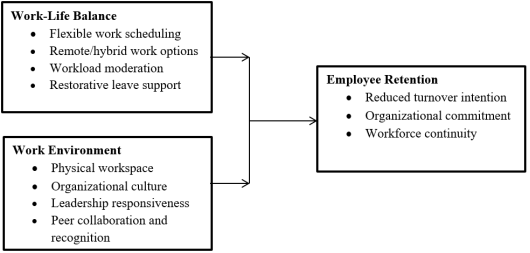
Conceptual Framework
Independent Variables
Figure 1. Conceptual Framework.
3. Research Methodology
This study adopts a desk review methodology, a structured research approach that synthesizes existing scholarly and institutional literature to generate analytical insights without primary data collection. Desk reviews are particularly appropriate when examining conceptual relationships and identifying patterns across diverse studies.
The methodology emphasizes systematic selection, critical evaluation, and thematic integration of secondary sources, ensuring transparency and analytical rigor. Literature was drawn from peer-reviewed journals, academic books, doctoral dissertations, and credible institutional publications addressing wellness programs, work–life balance, work environment, and employee retention.
Inclusion criteria required that sources demonstrate conceptual relevance, methodological credibility, and contextual applicability to higher education or comparable organizational settings. Studies lacking academic rigor or clear methodological grounding were excluded to maintain analytical integrity.
Selected literature underwent thematic coding to identify recurring constructs related to employee wellbeing, organizational support, and retention mechanisms. This analytical process enabled cross-study comparison and synthesis, moving beyond descriptive summaries toward integrated interpretation.
The desk review approach is justified by the multidimensional nature of wellness and retention dynamics. By consolidating fragmented evidence, the methodology provides a coherent analytical framework capable of informing institutional practice and future empirical research. While secondary synthesis limits direct generalization, thematic convergence strengthens the credibility of interpretive findings. Ethical considerations were upheld through accurate citation, objective interpretation, and adherence to scholarly standards.
4. Discussion of Findings
Social Exchange Theory fundamentally postulates that associations are constructed on the give-and-take of resources whether tangible or intangible. In the context of public universities, employees expect institutional support, recognition, and fair working conditions, and they reciprocate with commitment, productivity, and loyalty. This reciprocal dynamic provides a powerful lens for understanding how wellness programs influence retention decisions, because employees interpret welfare initiatives as signals of institutional care and value. The findings indicate that wellness programs implemented within universities contribute significantly to employee satisfaction and organizational attachment. When employees perceive that their wellbeing is intentionally supported, they are more likely to develop emotional commitment and a sense of belonging to the institution. Wellness initiatives targeting physical health, psychological wellbeing, and work–life balance shape how employees experience their workplace. For instance, flexible working arrangements and supportive environments reduce stress and fatigue, thereby strengthening job satisfaction and retention intentions.
Employees in public universities often navigate demanding professional responsibilities alongside personal obligations. The absence of structured wellness mechanisms increases the likelihood of burnout, disengagement, and eventual turnover. Wellness programs that actively promote work–life balance help employees manage competing demands, creating space for recovery and sustained productivity. This balance enhances concentration, morale, and long-term institutional commitment.
A supportive and inclusive work environment also emerges as a critical retention factor. Universities that cultivate collaboration, peer support, and fair leadership structures create psychological safety that encourages employees to remain invested in institutional goals. Such environments reinforce trust and mutual respect, which are foundational elements of sustained employment relationships. An important observation is that universities implementing wellness initiatives in a structured and intentional manner experience stronger employee loyalty compared to institutions where programs exist only in principle. Symbolic or poorly coordinated wellness efforts rarely translate into measurable retention outcomes. Effective implementation requires leadership commitment, accessibility of programs, and alignment with broader human resource strategies. When wellness initiatives are embedded into institutional culture, employees perceive them as genuine investments rather than temporary interventions.
Overall, the discussion reinforces that employee retention in public universities is not solely influenced by financial incentives. Psychological wellbeing, institutional support, and professional respect collectively shape employees’ decisions to remain within an organization. Wellness programs therefore function as strategic retention infrastructures that stabilize workforce engagement and sustain academic performance.
5. Conclusions
The study sought to examine the influence of wellness programs on employee retention in public universities in Kenya through a structured desk review guided by Social Exchange Theory. The findings confirm that wellness initiatives play a decisive role in shaping employee perceptions of organizational support, satisfaction, and belonging. Work–life balance structures reduce occupational stress, enable effective management of personal and professional responsibilities, and promote psychological resilience. Supportive work environments enhance trust, fairness, and interpersonal collaboration, strengthening institutional attachment. Together, these dimensions form an integrated wellness ecosystem that directly influences employee retention behavior.
The analysis demonstrates that employee retention is fundamentally relational. Employees respond to perceived institutional care with reciprocal loyalty and sustained engagement. Universities that invest in structured wellness frameworks experience greater workforce stability, improved morale, and continuity in academic delivery.
Importantly, the effectiveness of wellness programs depends on implementation quality and institutional commitment. Fragmented or symbolic initiatives yield minimal impact, whereas coherent, well-supported wellness strategies generate meaningful retention outcomes. For Kenyan public universities operating under resource pressures, wellness programs provide a viable pathway to stabilizing employee engagement while enhancing institutional resilience.
This study contributes to scholarly discourse by synthesizing fragmented literature into a coherent analytical perspective linking wellness initiatives to retention outcomes. The conclusions underscore that employee wellbeing is not peripheral to institutional success but central to sustainable workforce management.
6. Recommendations
Based on the findings and conclusions of the study, several strategic recommendations are proposed to strengthen employee retention within public universities. First, universities should establish comprehensive and institutionalized wellness frameworks that integrate work–life balance policies, mental health support, and employee assistance programs within formal human resource structures. Such frameworks ought to be conceptualized as long-term institutional commitments rather than short-term welfare interventions, ensuring sustainability and consistent employee support.
In addition, flexible scheduling arrangements, workload moderation mechanisms, and structured leave support should be systematically implemented to minimize burnout while sustaining productivity. These practices should be subject to periodic review and adjustment to align with evolving academic and administrative demands. Similarly, leadership development initiatives should prioritize supportive and inclusive management practices, with training programs emphasizing effective communication, fairness, recognition, and employee engagement. Such leadership approaches reinforce psychological safety, trust, and organizational commitment.
Furthermore, universities should intentionally cultivate organizational cultures that promote collaboration, peer support, and professional belonging. Culture-building initiatives — including mentorship systems, teamwork structures, and recognition platforms — strengthen morale and reduce employee turnover risks. To ensure accountability and continuous improvement, institutions should introduce structured monitoring and evaluation mechanisms to assess the effectiveness of wellness programs. Data-driven evaluation enables evidence-based refinement, ensuring that wellness strategies remain relevant and impactful.
Finally, wellness initiatives should be explicitly aligned with broader institutional goals and human resource strategies to prevent fragmentation and maximize long-term retention outcomes. Future research is encouraged to incorporate primary empirical investigations within Kenyan public universities to validate and contextualize wellness frameworks. Such context-specific evidence will support informed policy refinement and institutional decision-making, thereby strengthening workforce sustainability.
Abbreviations
CUE | Commission for University Education |
HRM | Human Resource Management |
SET | Social Exchange Theory |
Author Contributions
David Jakana: Conceptualization, Data Curation, Formal Analysis, Methodology, Visualization, Writing – original draft
Rosemarie Wanyoike: Supervision, Conceptualization, Methodology, Project Administration, Validation, Resources, Writing – review & editing
Conflicts of Interest
The author declares no conflicts of interest.
References
| [1] |
Al-Harthy, B., & Yusof, R. (2022). A Conceptual Paper on Compensation and Benefits, Job Security, Work-Life Balance, Employee Retention and Localization in Oman. Global Business & Management Research, 14.
|
| [2] |
Arkoudea, D. (2024). Navigating occupational stress in Swedish Universities: An HR Perspective (University of Gothenburg).
|
| [3] |
Bahar, A. M., Islam, M. A., Hamzah, A., Islam, S. N., & Reaz, M. D. (2022). The efficacy of work-life balance for young employee retention: a validated retention model for small private industries. International Journal of Process Management and Benchmarking, 12(3), 367-394.
https://doi.org/10.1504/ijpmb.2022.122202
|
| [4] |
Boakye, A. O., Arpoh-Baah, B., Odoom, D., Afram, K. O. A. O., Addai, P., & Agyemang, D. (2022). Employee retention in institutions of higher learning: A study of some selected university colleges in Ghana. Journal of education and practice, 13(5), 42-53
https://doi.org/10.7176/jep/13-5-06
|
| [5] |
Fenech, R., Baguant, P., & Ivanov, D. (2021). The changing role of human resource management in an era of digital transformation. Journal of Management Information & Decision Sciences, 22(2), 7-12.
|
| [6] |
George, C. (2023). Retaining professional workers: what makes them stay?. Employee relations, 37(1), 102-121
https://doi.org/10.1108/er-10-2013-0151
|
| [7] |
Gundi, C. N., Tumwet, E. C., & Bowen, D. (2024). Effect of work-life balance on employee retention of Egerton University Academic Staff, Nakuru County, Kenya. European Journal of Human Resource Management Studies, 2(1), 9-13
https://doi.org/10.46827/ejhrms.v8i1.1777
|
| [8] |
Htun, W. T., & Bhaumik, A. (2022). Employees job satisfaction and retention at workplace. Journal of Positive School Psychology, 6(3), 4342-4346.
|
| [9] |
Iyiola, F. A. (2024). Strategies to Enhance Employee Knowledge Retention in Public and Private Universities (Doctoral dissertation, Walden University).
|
| [10] |
Jabbour, C. J. C., & Santos, F. C. A. (2022). The central role of human resource management in the search for sustainable organizations. The international journal of human resource management, 19(12), 2133-2154
https://doi.org/10.1080/09585190802479389
|
| [11] |
Karanja, B. G. (2025). The influence of work life balance on intention to leave among staff in public Universities in Kenya. International Journal of Academic Accounting, Finance & Management Research, 4(1), 5-11.
|
| [12] |
Mogeni, L. K. (2020). Work-Life Balance Practices and Employee Retention: A Study of Commercial Banks in Kenya (Doctoral dissertation, JKUAT-COHRED).
|
| [13] |
Molm, L. D. (2015). Homans's vision of social exchange. In George C. Homans (pp. 135-156). Routledge.
|
| [14] |
Mugo, M. N., & Siagi, A. (2024). Factors affecting retention of academic staff in selected private chartered universities in Kiambu County Kenya. International Journal of Social Sciences Management and Entrepreneurship (IJSSME), 8(2).
|
| [15] |
Muma, M. M., Ochego, C., Nzulwa, J., Ombui, K., Odhiambo, R., Wekesa, S., & Charles, M. (2019). Influence of employee relations strategies on retention of employees in universities in Kenya. International Journal of Social Science and Humanities Research, 7(2), 1-27.
|
| [16] |
Muturu, E. M., & Mose, T. (2019). Effect of work place environment on employee retention in selected supermarkets in Kenya. Human Resource and Leadership Journal, 4(1), 13-34.
https://doi.org/10.47941/hrlj.295
|
| [17] |
Naz, S., Li, C., Nisar, Q. A., Khan, M. A. S., Ahmad, N., & Anwar, F. (2020). A study in the relationship between supportive work environment and employee retention: Role of organizational commitment and person-organization fit as mediators. Sage Open, 10(2).
https://doi.org/10.1177/2158244020924694
|
| [18] |
Ngcamu, B. S., & Mantzaris, E. (2023). Corruption detection systems and skills, and employee retention in South African universities. Journal of Academic Ethics, 21(3), 519-539.
https://doi.org/10.1007/s10805-022-09466-0
|
| [19] |
Nkanata, S. N., Muchangi, D., & Kiiru, G. (2021). Influence of Work Schedules on Staff Retention in Public Level Five Hospitals in Kenya: Moderating Effect of Perceived Organizational Support. International Journal of Economics, Business and Management Research, 5(9), 44, 60-72.
|
| [20] |
Nkatha, M. F., & Kevin, W. (2022). Effects of employer branding on employee attraction and retention among institutions of higher learning; A case study of public universities in south eastern Kenya. International Journal of Business Management, 5(2), 127-143.
|
| [21] |
Rafiei, N., & Davari, F. (2020). The role of human resources management on enhancing the teaching skills of faculty members. Materia socio-medica, 27(1), 35-41
https://doi.org/10.5455/msm.2014.27.35-38
|
| [22] |
Raghuwanshi, S. (2023). Impact of work-life balance on employee retention and organisational performance (Doctoral dissertation, Dublin, National College of Ireland).
|
| [23] |
Salau, O., Worlu, R., Osibanjo, A., Adeniji, A., Atolagbe, T., & Salau, J. (2021). Determinants of retention strategies and sustainable performance of academic staff of government-owned universities in Nigeria. F1000Research, 9, 902.
https://doi.org/10.12688/f1000research.25011.2
|
| [24] |
Sindhuja, K., & Subramanian, S. S. (2020). Impact of work-life balance on employee retention-a study on banking sector. Shanlax International Journal of Management, 7(3), 78-81.
https://doi.org/10.34293/management.v7i3.1629
|
| [25] |
Sorn, M. K., Fienena, A. R., Ali, Y., Rafay, M., & Fu, G. (2023). The effectiveness of compensation in maintaining employee retention. Open Access Library Journal, 10(7), 1-14.
https://doi.org/10.4236/oalib.1110394
|
| [26] |
Taiko, W. (2024). Effect of staff retention strategies on organizational performance of public institutions in Kenya. Journal of Human Resource & Leadership, 8(4), 30-45.
https://doi.org/10.53819/81018102t2427
|
| [27] |
Thuo, E. M., & Wambugu, T. (2022). Influence of employee welfare practices on job satisfaction in selected universities in Kenya. International Journal of Social Science and Humanities Research, 10(3), 399-420.
|
| [28] |
Tomeyan, S. C., & Mose, T. (2025). Talent management and employee performance in private universities in Kenya. International Journal of Social Sciences Management and Entrepreneurship (IJSSME), 9(1).
|
| [29] |
Torsabo, N. (2021). Effect of work environment on employees retention in Adamawa state University Mubi, Nigeria. International Journal of Research and Innovation in Social Science, 5(10), 350-357.
|
| [30] |
Tucker, D. (2010). Social exchange theory: John Thibaut & Harold Kelley. In The Proceedings of the Laurel Highlands Communications Conference (pp. 124-130). Indiana University of Pennsylvania, Department of Communications Media.
|
| [31] |
Vadera, M. L., & Harsha, P. P. (2023). Impact of organizational environment policies of higher education institutions on retaining talented faculty members (JN Vyas University, Jodhpur).
|
| [32] |
Wakio, R. (2019). Influence of work environment on employee retention in level four and five hospitals in Machakos County (Doctoral dissertation).
|
| [33] |
Yang, T. H., Saad, A. B., & AlQershi, N. (2021). Relationship between working environment, job satisfaction and employee retention on medical doctors in government hospitals in Malaysia: an investigative study. Journal of Management Information and Decision Sciences, 24(1), 1-10.
|
| [34] |
Yusliza, M. Y., Noor-Faezah, J., Ali, N. A., Mohamad-Noor, N. M., Ramayah, T., Tanveer, M. I., & Fawehinmi, O. (2021). Effects of supportive work environment on employee retention: the mediating role of person-organisation fit. Industrial and Commercial Training, 53(3), 201-216.
https://doi.org/10.1108/ict-12-2019-0111
|
Cite This Article
-
APA Style
Jakana, D., Wanyoike, R. (2026). Wellness Programs and Employee Retention in Public Universities in Kenya: A Desk Review. Journal of Human Resource Management, 14(1), 98-105. https://doi.org/10.11648/j.jhrm.20261401.20
 Copy
|
Copy
|
 Download
ACS Style
Jakana, D.; Wanyoike, R. Wellness Programs and Employee Retention in Public Universities in Kenya: A Desk Review. J. Hum. Resour. Manag. 2026, 14(1), 98-105. doi: 10.11648/j.jhrm.20261401.20
Copy
|
Download
AMA Style
Jakana D, Wanyoike R. Wellness Programs and Employee Retention in Public Universities in Kenya: A Desk Review. J Hum Resour Manag. 2026;14(1):98-105. doi: 10.11648/j.jhrm.20261401.20
Copy
|
Download
-
@article{10.11648/j.jhrm.20261401.20,
  author = {David Jakana and Rosemarie Wanyoike},
  title = {Wellness Programs and Employee Retention in Public Universities in Kenya: A Desk Review},
  journal = {Journal of Human Resource Management},
  volume = {14},
  number = {1},
  pages = {98-105},
  doi = {10.11648/j.jhrm.20261401.20},
  url = {https://doi.org/10.11648/j.jhrm.20261401.20},
  eprint = {https://article.sciencepublishinggroup.com/pdf/10.11648.j.jhrm.20261401.20},
  abstract = {Public universities serve as vibrant pillars of learning, research, and societal development. However, these institutions increasingly face substantial challenges related to retaining skilled employees. The departure of academic and administrative personnel disrupts institutional continuity, compromises service delivery, and weakens educational quality. As a result, employee retention has emerged as a strategic priority in higher education management. The growing pressure on public universities, including heavy workload, constrained resource, and employee welfare concerns, has intensified the need for structured wellness initiatives that support workforce sustainability. This study presents a structured desk review investigating the influence of wellness programs on employee retention in public universities in Kenya. The review specifically examines how work–life balance practices and work environment conditions contribute to retention outcomes. Guided by Social Exchange Theory (SET), the study conceptualizes wellness programs as reciprocal organizational investments that strengthen employee commitment and loyalty. A systematic desk review methodology involving literature selection, thematic analysis, and analytical synthesis of peer-reviewed sources was applied. The synthesis demonstrates that wellness initiatives, including flexible work arrangements, supportive leadership, inclusive organizational culture, and employee welfare programs, enhance job satisfaction, psychological safety, and institutional attachment. These outcomes collectively influence retention behavior. The findings further indicate that the effectiveness of wellness initiatives depends on institutional consistency, implementation quality, and alignment with broader human resource practices. By integrating fragmented literature into a coherent analytical framework, this study contributes to evidence-based human resource management discourse in higher education.},
 year = {2026}
}
Copy
|
Download
-
TY  - JOUR
T1  - Wellness Programs and Employee Retention in Public Universities in Kenya: A Desk Review
AU  - David Jakana
AU  - Rosemarie Wanyoike
Y1  - 2026/03/14
PY  - 2026
N1  - https://doi.org/10.11648/j.jhrm.20261401.20
DO  - 10.11648/j.jhrm.20261401.20
T2  - Journal of Human Resource Management
JF  - Journal of Human Resource Management
JO  - Journal of Human Resource Management
SP  - 98
EP  - 105
PB  - Science Publishing Group
SN  - 2331-0715
UR  - https://doi.org/10.11648/j.jhrm.20261401.20
AB  - Public universities serve as vibrant pillars of learning, research, and societal development. However, these institutions increasingly face substantial challenges related to retaining skilled employees. The departure of academic and administrative personnel disrupts institutional continuity, compromises service delivery, and weakens educational quality. As a result, employee retention has emerged as a strategic priority in higher education management. The growing pressure on public universities, including heavy workload, constrained resource, and employee welfare concerns, has intensified the need for structured wellness initiatives that support workforce sustainability. This study presents a structured desk review investigating the influence of wellness programs on employee retention in public universities in Kenya. The review specifically examines how work–life balance practices and work environment conditions contribute to retention outcomes. Guided by Social Exchange Theory (SET), the study conceptualizes wellness programs as reciprocal organizational investments that strengthen employee commitment and loyalty. A systematic desk review methodology involving literature selection, thematic analysis, and analytical synthesis of peer-reviewed sources was applied. The synthesis demonstrates that wellness initiatives, including flexible work arrangements, supportive leadership, inclusive organizational culture, and employee welfare programs, enhance job satisfaction, psychological safety, and institutional attachment. These outcomes collectively influence retention behavior. The findings further indicate that the effectiveness of wellness initiatives depends on institutional consistency, implementation quality, and alignment with broader human resource practices. By integrating fragmented literature into a coherent analytical framework, this study contributes to evidence-based human resource management discourse in higher education.
VL  - 14
IS  - 1
ER  -
Copy
|
Download





 Share This Article
 Twitter
 Linked In
 Facebook