1. Introduction
In the contemporary professional landscape of Taiwan, overtime work has become a pervasive and normalized issue within the labor force. According to the 2024 survey conducted by the Ministry of Labor (
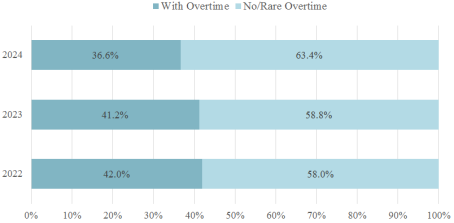
Figure 1), approximately 37% of the workforce reported extended working hours (overtime), while figures for 2022 and 2023 both exceeded 40%. Furthermore, data from
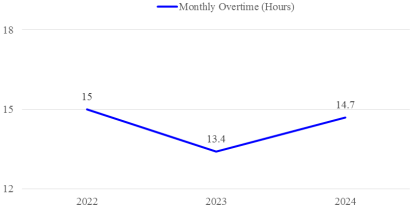
Figure 2 indicate that the average monthly overtime duration is 14.7 hours
. These statistics underscore the prevalence of labor exceeding standard working hours. Amidst the diversification of corporate operations, many employees are compelled to manage irregular overtime necessitated by temporary demands or specific job characteristics. Despite the evidentiary presumption established under Article 38 of the
Labor Incident Act, workers seeking overtime compensation must still substantiate their claims with attendance records and other relevant evidence. Conversely, employers retain the opportunity to present rebuttal evidence
, asserting that the overtime was performed without prior authorization, thereby potentially negating the recognition of such hours. This legal framework often presents significant hurdles for workers seeking overtime pay, as claims may be dismissed for lack of explicit evidentiary support.
Figure 1. Overtime Status of Taiwanese Workers (2022–2024).
Figure 2. Taiwan’s Average Monthly Overtime Hours (2022–2024).
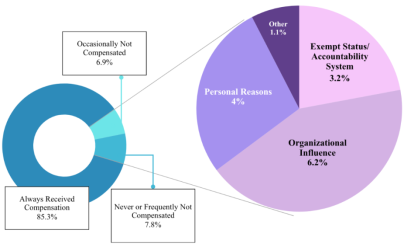
Figure 3. Overtime Pay and Compensatory Leave among Taiwanese Workers in 2024. Left: Status of receiving overtime pay or compensatory leave. Right: Main reasons why workers have not received overtime pay or compensatory leave.
Furthermore, many enterprises continue to misapply the "Professional Responsibility System" (Article 84-1 of the
Labor Standards Act) in managing employee work hours. Based on the 2024 statistical results of the Ministry of Labor’s survey on overtime compensation and compensatory time off (
Figure 3)
, 14.7% of workers reported failing to receive overtime pay or compensatory time off. Notably, 3.2% of these employees were informed that their roles were classified under the "responsibility system," precluding them from overtime eligibility. The contemporary emphasis on job autonomy has led to the exploitation of the responsibility system, resulting in the "autonomy paradox." In this paradox, excessive autonomy undermines collaborative efforts and exacerbates role ambiguity, ultimately leading to the "transfer" of working hours
| [8] | Fu, P.-H., & Wang, H.-L. (2010). The impact of corporate performance evaluation systems on labor rights and interests. National Chengchi University Journal of Labor Studies, 26, 91–146. https://doi.org/10.30388/BLR.201012_(26).0003 |
[8]
. Although some enterprises have implemented overtime application protocols, workers continue to face numerous challenges in practice, as they cannot always ensure their overtime hours are formally recognized, thereby undermining their legal right to compensation.
Current scholarship on voluntary overtime predominantly addresses labor rights, compensation claims, psychological motivations, and corporate management culture; however, limited attention has been directed toward the establishment of reasonable internal overtime policies. Consequently, the objectives of this research are twofold:
1) To examine the legal dimensions of voluntary overtime in Taiwan.
2) To address the existing research gap by proposing viable human resource management solutions.
This research utilizes a doctrinal legal methodology to interpret the core provisions of the Labor Standards Act and the Labor Incident Act in Taiwan. To enhance analytical rigor, the study incorporates a qualitative analysis of judicial precedents, specifically examining Taiwan High Court rulings to categorize legal standards for overtime recognition. This systematic framework ensures that the subsequent normative conclusions and policy recommendations are grounded in both statutory interpretation and judicial reality. This study employs a literature review to synthesize previous research on the problematic aspects of voluntary overtime, followed by an analysis of landmark judicial precedents in Taiwan on voluntary overtime disputes. Finally, the study offers conclusions and policy recommendations.
2. Literature Review
2.1. Defining Voluntary Overtime Under Taiwanese Labor Law
Regarding the regulation of working hours, Article 30, Paragraph 1 of the Labor Standards Act stipulates: "A worker’s normal working hours shall not exceed eight hours per day and 40 hours per week." However, if an employer requires a redistribution of working hours due to the specific nature of the industry, job characteristics, or business demands, they may—upon consent from the labor union or, in the absence of a union, a labor-management conference—implement "flexible working hours" based on two-week, four-week, or eight-week cycles. Work performed beyond regular working hours is defined as "overtime." Nevertheless, overtime is not arbitrary or unprotected; Article 32, Paragraph 2 of the Labor Standards Act provides that an employer may extend daily working hours to a maximum of 12 hours and monthly overtime to a maximum of 46 hours. Any further demand for increased hours requires union or labor-management conference approval and must be filed with the competent authority for record-keeping.
To compensate workers for the additional labor provided, employers are obligated to pay overtime wages. The legal framework adopts a "price-to-control-volume" approach
| [24] | Wang, P.-Y. (2018). Statutory standards and contractual calculation methods for overtime compensation. Taipei University Law Review, 108, 154–190.
https://doi.org/10.6774/TULR |
[24]
under Article 24 of the
Labor Standards Act, which defines the standards for extended working hour wages: "An employer who extends the working hours of a worker shall pay the worker wages for the extended hours according to the following standards: 1. At least one-third more than the regular hourly rate for the first two hours; 2. At least two-thirds more than the regular hourly rate for the next two hours; 3. Double the regular hourly rate if overtime is extended under Article 32, Paragraph 4. For work on rest days under Article 36, the first two hours are paid at an additional one and one-third times the regular hourly rate, and subsequent hours at an additional one and two-thirds times." Alternatively, following the addition of Article 32-1 to the
Labor Standards Act, workers may, of their own volition and with employer consent, choose compensatory time off in lieu of overtime pay.
Based on current legal provisions, a distinction can be drawn between "overtime" and "voluntary overtime." Overtime refers to the extension of hours requested by the employer under statutory procedures involving union or conference consent. In contrast, voluntary overtime refers to overtime behavior initiated by the worker based on personal needs or will, without an explicit request from the employer.
However, employers who bear the management responsibility for working hours do not necessarily welcome voluntary overtime. One primary reason is the dispute over the recognition of "working hours." Current judicial rulings generally define working hours as "the time during which a worker provides labor under the command and supervision of the employer, or the time during which a worker engages in business under the express or implied consent of the employer"
| [12] | Hou, Y.-H. (2010). The development and implications of the legal recognition of working time and standby time in Japan. Taipei University Law Review, 75, 181–210.
https://doi.org/10.6774/TULR.201009.0175 |
[12]
. Thus, the criterion is not merely whether labor was performed, but whether the worker's labor was at the employer's disposal. For instance, standby periods during which a worker is prepared to perform labor remain subject to the employer's command and supervision, preventing the worker from enjoying free activities; such periods are therefore recognized as working hours.
Another reason is the Supreme Administrative Court, Judgment No. 373 of the 108th Year (2019), which explicitly requires that "attendance records must document the 'time of arrival at and departure from the workplace' rather than solely the 'working hours.'" Working hours must be recorded to the minute. Consequently, if a worker remains at the workplace during non-working periods, these may still be recorded. This measure, designed to protect labor rights, has led enterprises to oppose voluntary overtime because of the difficulty in distinguishing actual labor hours from mere presence, prompting employers to object when workers unilaterally claim overtime pay.
2.2. A Critical Turning Point: The Adoption of Article 38 of the Labor Incident Act
Administrative Letter Lao-Tung-2-Tzu No. 0960062674 from the former Council of Labor Affairs (now Ministry of Labor) noted: "If work rules stipulate that overtime requires prior application and consent, such rules are permissible provided they do not violate mandatory prohibitions. However, if a worker automatically provides labor at the workplace beyond normal hours and the employer does not express opposition or implement preventive measures, the duration of labor still constitutes working hours for which wages must be paid according to the Labor Standards Act." This indicates that overtime may be initiated by the worker, who has the right to request it rather than merely wait for the employer's consent.
In the absence of an overtime application system, overtime pay is recognized as long as the employer does not oppose overtime or implement preventive measures (such as automatic power-offs) and the worker has indeed provided labor. Consequently, some enterprises seek to use an "overtime application system" to rebut the "presumption of working hours," arguing that work performed without a formal application constitutes "duties performed unilaterally without employer consent" and should not be calculated as working hours. This has raised the legal controversy of whether an application system can serve as rebuttal evidence to overturn the presumption under Article 38 of the
Labor Incident Act .
Before Article 38, the judicial landscape presented two situations. In the first, workers claiming overtime had to bear the heavy burden of proving the facts, hours, and content of their labor. Employers could rebut such claims by citing "failure to follow application procedures" or "work rules prohibiting unapproved overtime". In the second situation, courts held that "an application system is merely one method of confirming overtime; attendance records are the primary evidence, and applications are auxiliary tools. Employers may not deny the fact of overtime solely due to the lack of an application.
Subsequently, Article 38 of the Labor Incident Act (enacted in 2018, implemented in 2020) stipulated: "Attendance records documenting a worker's presence presume that the worker was performing duties with the employer's consent during that time." This aims to resolve the difficulty workers face in proving labor beyond regular hours, thereby reducing their evidentiary burden. The law presumes both "performance of duties" and "employer consent" for the time recorded, and the employer may no longer require the worker to bear the burden of proof for these facts.
Ultimately, employers have a statutory duty to maintain attendance records as part of their management responsibilities. If records are inaccurate, the employer must promptly handle and correct them, as they possess superior evidentiary value regarding working hours
| [7] | Chiu, Y.-F. (2021). Overtime application systems and the application of Article 38 of the Labor Incident Act: A case comment on Taiwan High Court Taichung Branch Civil Judgment No. 13 (Year 109). Taiwan Law Review: Judicial Decisions Monthly, 104, 48–58.
https://doi.org/10.3966/207798362021020104006 |
[7]
. Furthermore, it is often difficult to distinguish whether a worker is "voluntarily" staying or staying due to the necessity of assigned tasks, which implies tacit consent.
The legal ambiguity surrounding voluntary overtime is fundamentally a tension between the
Labor Standards Act's rigid hour limits and the evidentiary flexibility introduced by the
Labor Incident Act. Under Article 30 and 32 of the
Labor Standards Act, overtime is framed as an employer-driven request requiring union or labor-management consent. However, Administrative Letter Lao-Tung-2-Tzu No. 0960062674 clarifies that even without a formal request, if a worker provides labor beyond regular hours and the employer fails to express opposition or implement preventive measures, the duration must be recognized as working hours. This administrative guideline establishes that "employer consent" may be inferred from "non-opposition." The implementation of Article 38 of the
Labor Incident Act in 2020 further solidified this by creating a legal presumption: if a worker is present at the workplace, they are presumed to be working with the employer's consent. As Chiu (2021)
| [7] | Chiu, Y.-F. (2021). Overtime application systems and the application of Article 38 of the Labor Incident Act: A case comment on Taiwan High Court Taichung Branch Civil Judgment No. 13 (Year 109). Taiwan Law Review: Judicial Decisions Monthly, 104, 48–58.
https://doi.org/10.3966/207798362021020104006 |
[7]
analyzed, this shifts the burden of proof to the employer, who must provide concrete evidence to rebut the presumption. While Hsu (2024)
argues that an internal "overtime application system" can serve as such rebuttal evidence, recent judicial trends show a more nuanced interpretation.
For instance, in the Taiwan High Court Civil Judgment No. 45 of the 109th Year, the court dismissed the employer's defense that the worker failed to file an overtime application, ruling that the physical presence recorded in attendance logs overrides procedural omissions if the employer cannot prove the worker was not performing duties. Similarly, Judgment No. 15 of the 111th Year (Taichung Branch) rejected the validity of overtime application rules that were not properly announced or implemented, categorizing such procedures as "illegal employer maneuvers" to evade compensation. This study builds upon the legal foundations laid by Chiu (2021)
| [7] | Chiu, Y.-F. (2021). Overtime application systems and the application of Article 38 of the Labor Incident Act: A case comment on Taiwan High Court Taichung Branch Civil Judgment No. 13 (Year 109). Taiwan Law Review: Judicial Decisions Monthly, 104, 48–58.
https://doi.org/10.3966/207798362021020104006 |
[7]
and Hsu (2024)
. While their work focuses primarily on the procedural weight of evidence in litigation, this paper provides a more integrated contribution by analyzing the "Autonomy Paradox". We argue that the legal presumption under Article 38 should not only be seen as a litigation tool but as a catalyst for "Strategic Human Resource Management". This study’s novel contribution is to demonstrate that without structural reforms to work allocation, legal application systems will remain ineffective at rebutting the presumption of consent, thereby leaving employers exposed to significant back-pay liabilities.
2.3. Judicial Perspectives on Voluntary Overtime
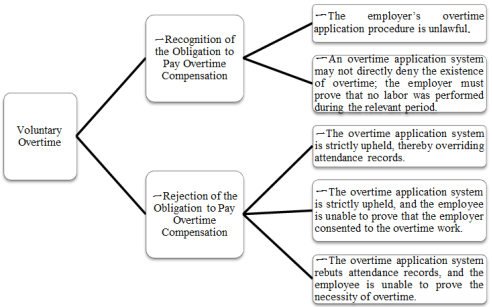
The following analysis is based on the Taiwan High Court's judgments and examines whether overtime pay is recognized in cases involving voluntary overtime. The classification framework is adapted from Hsu (2023)
| [14] | Hsu, R.-Y. (2023). Autonomous overtime among contemporary workers: The transfer of working time burdens (Master’s thesis). National Chengchi University.
https://hdl.handle.net/11296/5scj5g |
[14]
.
Table 1. Major Taiwanese court decisions recognizing the obligation to pay overtime compensation.
Case Number | Case Description | Category |
Taiwan High Court, Taichung Branch, Civil Judgment No. 15 of the 111th Year, Lao-Shang-Tzu2 | The employer used a worker's prior infringement of others' rights to force the worker to sign a "repentance letter" waiving severance and overtime pay, thereby constituting an improper linkage. Although the firm claimed an application system existed, the terms were added to work rules without proper announcement via email or other means; thus, the rules were not legally effective. The argument that the worker failed to apply for overtime was rejected. | Illegal employer overtime application procedure |
Taiwan High Court, Kaohsiung Branch, Civil Judgment No. 41 of the 109th Year, Lao-Shang-Yi-Tzu2 | The employer claimed overtime required prior application and approval. However, the personnel regulations lacked specific rules for overtime pay or compensatory leave. The court found the regulations were not actually implemented and relied on attendance records under the Labor Standards Act. The employer failed to prove the worker was merely eating or intentionally delaying departure. | Illegal employer overtime application procedure |
Taiwan High Court, Civil Judgment No. 102 of the 109th Year, Lao-Shang-Yi-Tzu | The employer claimed that a mandatory application system was announced. However, the enterprise's attendance records were contested as inauthentic. The court ruled that the employer failed to prove the records were true. Given the statutory duty to preserve records, the court recognized the fact of extended working hours. | The application system cannot directly negate overtime facts; the employer must prove that labor was not provided |
Taiwan High Court, Kaohsiung Branch, Civil Judgment No. 45 of the 109th Year, Lao-Shang-Tzu | The employer cited work rules requiring "overtime slips" or phone reports. The court, citing Article 38 of the Labor Incident Act, ruled that the employer failed to prove the worker was not performing duties. The argument that the worker failed to complete a supplementary application before the monthly closing was dismissed. | The application system cannot directly negate overtime facts; the employer must prove that labor was not provided |
Taiwan High Court, Civil Judgment No. 57 of the 109th Year, Lao-Shang-Tzu | The employer claimed workers stayed late for personal reasons and failed to follow the application system for tasks like client meetings. The court found the employer failed to prove the absence of labor. Furthermore, the company routinely paid a 70 New Taiwan Dollars (NTD) meal allowance for staying past 7 PM, which effectively rebutted the employer's defense. | The application system cannot directly negate overtime facts; the employer must prove that labor was not provided |
Figure 4. Classification of Taiwanese court decisions on disputes concerning voluntary overtime.
Below is the formal academic translation of the provided sections (2.1 to 2.4). The terminology follows international legal standards, names are rendered using the Wade-Giles system (Ministry of Foreign Affairs style) with first names omitted, and all footnotes are consolidated at the end of the text.
2.4. Summary
The discourse surrounding voluntary overtime has transitioned from a narrow focus on wage disputes to a broader examination of the "Autonomy Paradox" and structural organizational failures. While earlier legal scholarship emphasized the binary distinction between employer-directed and employee-initiated work, contemporary research suggests that digital transformation has blurred these boundaries. For instance, Zhao and Wu (2023)
| [28] | Zhao, L., & Wu, L. (2023). How does digital office affect overtime through job autonomy in China? A nonlinear mediating model for the autonomy paradox. Technology in Society, 72. https://doi.org/10.1016/j.techsoc.2022.102181 |
[28]
demonstrate that in a digital office environment, increased job autonomy often leads to increased voluntary overtime, as workers feel a heightened sense of responsibility and a constant need to be available. This finding aligns with the "autonomy-control" perspective, which suggests that the freedom to choose when to work paradoxically results in self-exploitation to meet performance goals.
Furthermore, the psychological toll of this phenomenon cannot be ignored. Houdmont, Zhou, and Hassard (2011)
| [13] | Houdmont, J., Zhou, J., & Hassard, J. (2011). Overtime and psychological well-being among Chinese office workers. Occupational Medicine, 61(4), 270–273.
https://doi.org/10.1093/occmed/kqr029 |
[13]
identify a direct correlation between excessive overtime and diminished psychological well-being, suggesting that the "voluntary" nature of the work does not mitigate its negative health impacts. This is corroborated by Albrecht, Leineweber, and Kecklund (2024)
| [1] | Albrecht, S. C., Leineweber, C., & Kecklund, G. (2024). Prospective effects of work-time control on overtime, work–life interference and exhaustion in female and male knowledge workers. Scandinavian Journal of Public Health, 52(2), 205–215.
https://doi.org/10.1177/14034948221150041 |
[1]
, who argue that even when workers possess high work-time control, they still experience significant exhaustion if the organizational culture prioritizes "total commitment" over sustainable practices.
While existing legal literature in Taiwan, such as Hsu (2023)
| [14] | Hsu, R.-Y. (2023). Autonomous overtime among contemporary workers: The transfer of working time burdens (Master’s thesis). National Chengchi University.
https://hdl.handle.net/11296/5scj5g |
[14]
, provides a comprehensive overview of how courts interpret Article 38 of the
Labor Incident Act, there remains a significant gap in integrating these legal outcomes with practical human resource interventions. Chiu (2021)
| [7] | Chiu, Y.-F. (2021). Overtime application systems and the application of Article 38 of the Labor Incident Act: A case comment on Taiwan High Court Taichung Branch Civil Judgment No. 13 (Year 109). Taiwan Law Review: Judicial Decisions Monthly, 104, 48–58.
https://doi.org/10.3966/207798362021020104006 |
[7]
has explored how overtime application systems serve as rebuttal evidence, yet the scholarship often treats legal compliance as a reactive measure rather than a proactive management strategy.
This study contributes to the literature by moving beyond the descriptive analysis of case law to propose a Strategic Human Resource Management framework. Drawing on the workforce inventory concepts established by Yu (2000)
, this paper argues that resolving voluntary overtime disputes requires a fundamental shift from individual time-tracking to organizational workload balancing. Unlike previous research that focuses solely on the burden of proof, this study integrates judicial precedents with management solutions to provide a roadmap for reducing "involuntary" voluntary overtime.
In summary, although this study does not address procedural law, the determination of overtime pay hinges on whether the parties agreed to extended working hours, whether labor was actually performed, and whether the employer established a lawful and reasonable overtime application system. While Article 38 allows attendance records to create a presumption of employer consent, courts permit rebuttal through contracts, work rules, and management evidence. Thus, attendance records alone do not automatically establish overtime entitlement; courts continue to emphasize factual clarity and the nature of the labor performed to prevent employers from being unfairly burdened with overtime obligations arising solely from an employee’s unilateral presence.
3. Corporate Practical Dilemmas
The overtime behavior of Labors is often not a result of entirely autonomous choice; instead, it is shaped by an intricate interplay of multiple factors, including external reward systems, conformity driven by organizational climate
| [10] | Hackman, J. R. (1992). Group influences on individuals in organizations. In M. D. Dunnette & L. M. Hough (Eds.), Handbook of industrial and organizational psychology (Vol. 3, pp. 1455–1525). Consulting Psychologists Press. |
[10]
, and internal self-image construction. When an organizational culture emphasizes commitment and performance—viewing overtime as a symbol of responsibility and professional identity—what is labeled as "voluntary" overtime may evolve into a stress response rather than a genuine proactive choice.
Consequently, Watanabe and Yamauchi (2018)
| [25] | Watanabe, M., & Yamauchi, K. (2018). The effect of quality of overtime work on nurses’ mental health and work engagement. Journal of Nursing Management, 26(6), 679–688.
https://doi.org/10.1111/jonm.12595 |
[25]
argue that truly addressing the issues and impacts of overtime requires a preliminary understanding of the underlying reasons for such behavior. According to the
Survey on Labor Life and Employment Conditions conducted by the Ministry of Labor in Taiwan, the reasons for overtime are categorized into eight types: (1) urgent orders or business requirements (temporary or due to work characteristics requiring handling outside of regular hours), 45.6%; (2) excessive workload or meetings, 25.5%; (3) earning overtime pay, 11.2%; (4) organizational culture of the service unit, 6.8%; (5) passion for and full commitment to work, 6.1%; (6) supervisor's request for overtime, 2.3%; (7) pursuit of performance ratings, promotions, or performance bonuses, 1.7%; and (8) others, 0%
.
Although these statistics may encompass both consensual extensions of working hours and voluntary overtime, both scenarios indicate structural pressures or gaps in work processes, business arrangements, or manpower scheduling. These gaps compel Labors to handle tasks outside regular working hours. Therefore, even if the statistical results represent a hybrid of these two conditions, the practical phenomena they reflect remain significant and warrant detailed discussion in this paper.
3.1. Job Characteristics and Industry Culture
By industry category, the highest proportions of extended working hours driven by "urgent orders or business requirements" are found in
Mining and Quarrying (72.8%),
Arts, Entertainment, and Recreation (66.6%), and
Publishing, Audiovisual, and Information and Communication Technology (65.9%)
. These figures reflect the high degree of uncertainty and time-sensitivity inherent in these jobs. For instance, mining and quarrying are constrained by weather and environmental factors, making them subject to production schedules and construction period limits. Meanwhile, the arts, entertainment, and information and communication technology sectors are often project-based, requiring alignment with market timelines and trending topics. During peak event periods, workloads are concentrated and cannot be interrupted. These industries, characterized by irregular task nature and strong project orientation, frequently face temporary demands or emergencies, leading to a results-driven environment where overtime is indispensable for completing tasks.
Thus, while overtime in these industries may appear "voluntary" on the surface, it is profoundly tied to industrial structures and workflows. This often places Labors in high-pressure environments where clearly refusing overtime is difficult, negatively impacting their quality of life and physical and mental health
| [17] | Jiang, Y., & Yang, F. (2025). Overtime work and Chinese workers’ physical and mental health: The mediating role of social support and work value awareness. Work, 80(1), 141–154. https://doi.org/10.3233/WOR-240041 |
[17]
. Furthermore, this complicates the burden of proof in overtime pay claims, further blurring the line between voluntary and forced labor. Without robust work-hour management and overtime application systems, enterprises will struggle to address this issue fundamentally.
Such prolonged working hours are frequently misused by companies under the label of the "responsibility system." However, the original legal definition under Article 84-1 of the Labor Standards Act is strictly limited to specific categories designated and announced by the Ministry of Labor, such as supervisory and management personnel, professional exempt staff, workers with supervisory or intermittent tasks, or other roles with a special nature. Only for these roles can employers and employees negotiate work hours, leave, and holidays separately, and the resulting agreements must be submitted in writing to local authorities for approval to bypass the restrictions of Articles 30, 32, 36, and 37. Such agreements must be in writing and must not jeopardize the health or well-being of the Labor. Today, this system is often abused as a pretext to demand "voluntary" overtime from any worker in a "task-oriented" role that prioritizes results over process.
3.2. Human Resource Allocation and Management Issues
In the normalization of extended working hours, beyond individual psychology and organizational culture, deeper causes often lie in the gaps within corporate human resource allocation and internal management systems
| [22] | Seo, J.-W. (2011). Excessive overtime, workers, and productivity: Evidence and implications for Better Work (Better Work Discussion Paper No. 2). International Labour Organization & International Finance Corporation.
https://www.ilo.org/publns |
[22]
. To resolve this, enterprises must conduct human resource inventories regarding staffing and task distribution to implement overall organizational change and achieve Strategic Human Resource Management.
First, regarding staffing, assessing manpower demand remains a primary challenge for employers. The pinnacle of human resource utilization is "utilizing specialized skills for their intended purpose"—that is, "placing the right person in the right position." Proper manpower utilization should achieve a balance between "quality" and "quantity": qualitatively, ensuring each employee maximizes output in their role; and quantitatively, balancing the company's production capacity with demand
| [5] | Chen, Y.-C., Fan, S.-C., & Dai, H.-J. (2020). Developing workforce allocation indicators for the medical device industry. Journal of Technology and Human Resource Education, 7(2), 5–32. https://doi.org/10.6587/JTHRE.202012_7(2).0001 |
[5]
. Many firms, driven by cost considerations, engage in excessive downsizing, forcing a single employee to shoulder the workload originally intended for two or three people. While this "one person doing the work of three" approach may reduce personnel expenses in the short term, it often leads to declining quality, increased error rates, and the long-term risk of burnout and high stress
| [23] | Steel, P., & House, A. (2024). Short-term pain for long-term gain? A longitudinal meta-analysis of downsizing–financial performance relationships. Frontiers in Behavioral Economics, 3. https://doi.org/10.3389/frbhe.2024.1237750 |
[23]
. Furthermore, Olds and Clarke (2010)
point out that overtime is frequently used as a tool to meet manpower demands, treating regular operations as a flexible space "solvable by overtime". Without proper human resource planning and workload assessment, companies fall into a vicious cycle of using overtime to bridge manpower gaps. In the long run, such allocation is detrimental to sustainable development and negatively impacts employee health and retention
| [2] | Amadhila, O., & Bhebhe, T. (2022). Examining the effects of understaffing on employee performance at the Forensic Pathology Division, Namibia Police Force. International Journal of Recent Research in Interdisciplinary Sciences, 9(4), 11–24. https://doi.org/10.5281/zenodo.7391783 |
[2]
.
Secondly, the frequent and normalized occurrence of short-term tasks and temporary demands reflects deficiencies in a firm's predictive capabilities, scheduling logic, and cross-departmental communication, as well as management chaos
| [9] | Gilardi, S., & Lazazzara, A. (2025). Organizational climate for temporariness: Exploring employees’ shared perceptions within intra-organizational temporary forms. International Journal of Project Management, 43(4), 102720.
https://doi.org/10.1016/j.ijproman.2025.102720 |
[9]
. If an organization cannot foresee peak periods through effective resource planning or establish real-time coordination systems, employees are forced to extend work hours to cope with sudden pressures, resulting in excessive workloads
. This indicates that enterprises may rely too heavily on individual flexibility and responsibility rather than institutionalized task allocation and support mechanisms. Such operations become over-dependent on individuals, ignoring the potential for team collaboration and process improvement
.
Finally, the institutional arrangement of "clock-in for attendance, but responsibility-based for clock-out"
| [18] | Lin, H.-Y., & Lu, L. (2013). Working to exhaustion? A cross-cultural theoretical model of presenteeism. Journal of Human Resource Management, 13(3), 29–55.
https://doi.org/10.6147/JHRM.2013.1303.02 |
| [26] | Yang, C.-L., Huang, R.-H., Huang, C.-L., & Liang, C.-H. (2016). Barriers to corporate social responsibility implementation and strategic responses. Journal of Management Research, 16(1), 1–31. https://doi.org/10.6626/MR.2016.16(1).01 |
[18, 26]
further deepens the invisibility of labor and the ambiguity of overtime facts. Many companies maintain formal clock-in systems while using "responsibility" or "task orientation" as justifications for requiring after-hours work without recording it or providing compensation. This design makes it difficult for human resource departments to track actual working time and creates significant hurdles for labors seeking to provide evidence for overtime pay claims. More importantly, this creates substantial legal risks should labor disputes arise in the future
.
In summary, if enterprises wish to mitigate burnout and involuntary "voluntary" overtime, they cannot rely solely on labor self-discipline or cultural adjustments. They must return to the core of human resource management: re-examining the rationality of staffing, the effectiveness of collaboration, the smoothness of workflows, and whether institutional systems accurately reflect actual work input
| [2] | Amadhila, O., & Bhebhe, T. (2022). Examining the effects of understaffing on employee performance at the Forensic Pathology Division, Namibia Police Force. International Journal of Recent Research in Interdisciplinary Sciences, 9(4), 11–24. https://doi.org/10.5281/zenodo.7391783 |
[2]
. Only by addressing these structural management issues can the premise of "voluntariness" be realized, establishing a sustainable working environment for both labor and management
| [3] | Barker Scott, B. A., & Manning, M. R. (2024). Designing the collaborative organization: A framework for how collaborative work, relationships, and behaviors generate collaborative capacity. The Journal of Applied Behavioral Science, 60(1), 149–193.
https://doi.org/10.1177/00218863221106245 |
[3]
.
4. Conclusion and Recommendations
The normative recommendations proposed in this study are directly derived from the intersection of the empirical data presented in
Figure 3 and the judicial analysis in
Table 1. The finding that 14.7% of Taiwanese workers fail to receive overtime compensation — often due to organizational influence (6.2%) or misapplied accountability systems (3.2%) — demonstrates that voluntary overtime is a systemic rather than an individual issue. While Olds and Clarke (2010)
argue that overtime is frequently used as a flexible mechanism to address manpower demands, our analysis of Taiwan High Court precedents suggests that this flexibility creates significant latent legal risks when it bypasses formal application procedures.
Specifically, Chiu (2019)
emphasizes that the presumption of working hours under Article 38 of the
Labor Incident Act places an immense evidentiary burden on employers. This study advances the scholarship by connecting this legal burden to the "autonomy paradox" identified in Section 3.1. We argue that the prescriptive shift toward strategic workforce planning is not merely an aspirational management goal but a necessary legal defense. Unlike the generalized workforce inventory methods discussed by Yu (2000)
, this research demonstrates that in a legal environment where attendance records presume consent, employers must adopt "utilizing specialized skills for their intended purpose" to ensure that task distribution does not inadvertently create the "one person doing the work of three" scenario. Consequently, our suggestions for structural reform—such as real-time coordination systems and formalizing implied consent—are grounded in the evidence that procedural management alone is insufficient to rebut legal presumptions when actual labor is performed.
Drawing on the foregoing analysis, the phenomenon commonly described as “clocking in under a time‐tracking system while operating under a responsibility‐based system after clocking out” reveals a structural disjunction and ambiguity between recorded working hours and the actual provision of labor in parts of Taiwan’s workplaces. The normalization of overtime is not solely a consequence of industrial structure or labor shortages; it is also deeply embedded in organizational cultures that place excessive emphasis on performance, commitment, and availability. When responsibility‐based employment arrangements and flexible working‐time systems are implemented without clear boundaries or effective oversight, they are prone to being instrumentalized to conceal actual working hours and circumvent employers’ obligations to pay overtime compensation. As a result, employees are often placed in a condition that appears voluntary in form but is substantively difficult to refuse in practice—an arrangement that not only undermines labor rights but also disrupts work–life balance, generating psychological strain, physical exhaustion, and long‐term efficiency losses.
From an operational perspective, firms that lack reasonable workforce planning and flexible staffing mechanisms often resort to a “one person performing the work of several” model to cope with routine tasks and unexpected demands. While such practices may sustain short‐term operations, they ultimately impose high costs in terms of work quality, employee burnout, and labor turnover. When task allocation and organizational communication fail to align effectively, overtime becomes a default solution for compensating institutional deficiencies, thereby reinforcing a self‐perpetuating cycle in which extended working hours substitute for systematic management reform. In such contexts, employees may be required to continue working after clocking out or have their overtime demands dismissed on the grounds of perceived inefficiency, leading not only to imbalanced labor relations but also to blurred lines of responsibility and weakened protection of labor rights.
From a legal standpoint, overtime application systems constitute merely one tool for managing working time and should not be misused as evidence to the detriment of employees’ fundamental rights. Employers should not disregard the labor actually performed during overtime simply because employees failed to submit formal applications, nor should such procedural omissions be invoked to evade statutory obligations to provide lawful wage compensation. Even where employees do not immediately claim overtime pay, this does not eliminate the employer’s legal exposure. Subsequent claims may still give rise to obligations for back pay and compensation, thereby creating latent legal risks for employers.
Ultimately, enterprises must pursue a fundamental transformation of organizational culture by abandoning the flawed valuation of excessive overtime as a marker of dedication or performance. Instead, prioritizing employees’ physical and mental well‐being and supporting work–life balance can enhance productivity while strengthening long‐term organizational competitiveness. Only through the integrated alignment of managerial practices, legal compliance, and organizational culture can firms effectively address overtime issues and establish lawful, humane working environments. Such an approach enables employees to fully exercise their professional capabilities and potential without sacrificing personal well‐being or enduring the silent psychological costs of sustained overwork.





 Share This Article
 Twitter
 Linked In
 Facebook
 Copy
Copy Download